Delaware, known as “The First State” for being the first to ratify the U.S. Constitution, has just three counties, the fewest of any U.S. state. Despite its small size, Delaware includes densely populated urban areas, coastal communities, wetlands, and large agricultural areas. New Castle County dominates the urban north, Kent County occupies the center of the state, and Sussex County extends across the southern coastal plain.
✅Delaware County Map
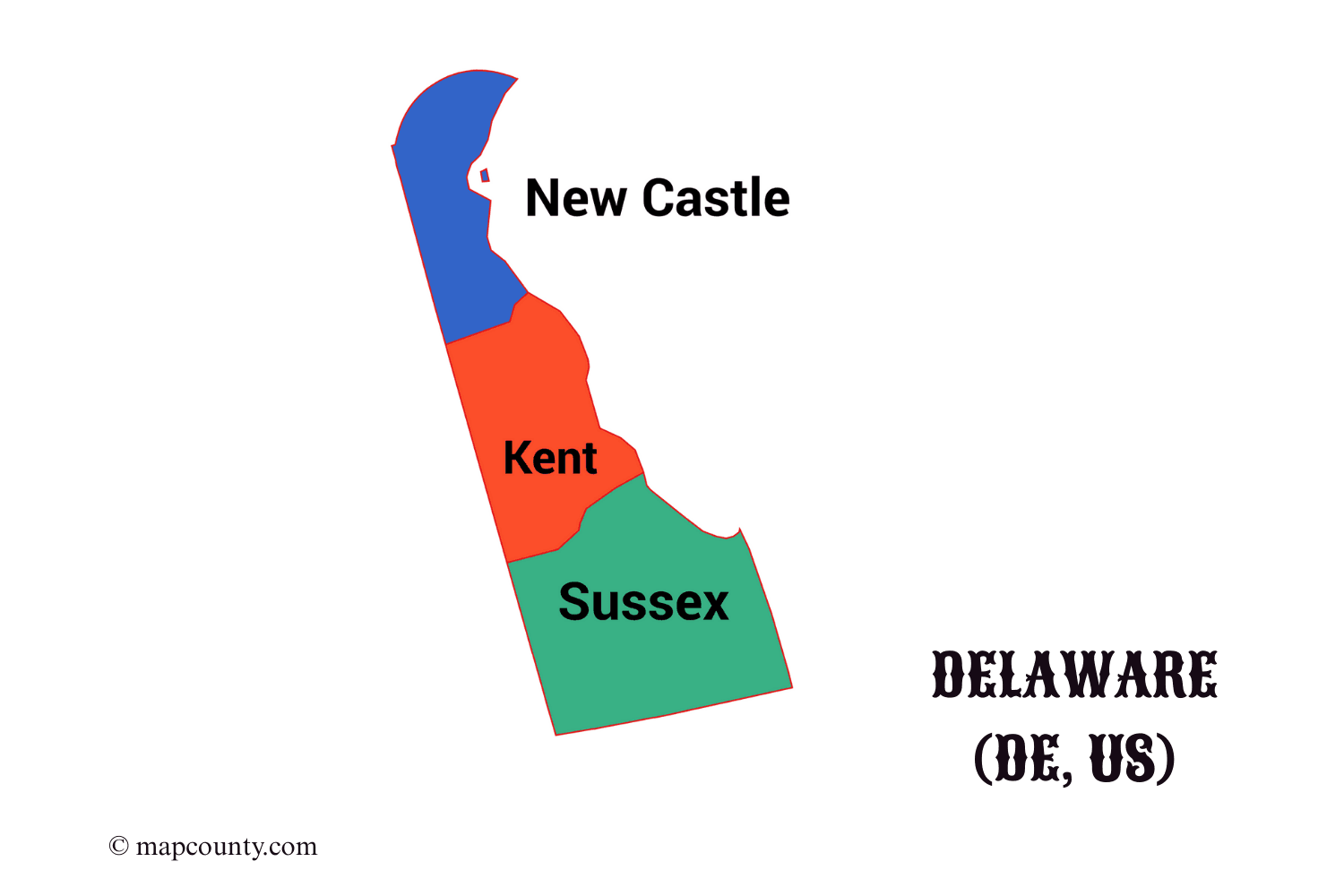
Delaware Counties: Seats, Establishment Dates & Land Area
| County | County Seat | Established | Land Area (sq mi) |
|---|---|---|---|
| New Castle | Wilmington | 1673 | 426 |
| Kent | Dover | 1680 | 586 |
| Sussex | Georgetown | 1683 | 936 |
County Governance Structure
Delaware’s three counties vary in geography, population, and local government structure. Their governing bodies are organized differently:
- New Castle County has an elected County Executive and a County Council that serves as the legislative branch.
- Kent County is governed by the elected Levy Court, whose commissioners appoint a County Administrator to oversee day-to-day operations.
- Sussex County is governed by an elected County Council, with county administration handling daily government operations.
- County offices include functions such as planning and zoning, property assessment, the sheriff, recorder of deeds, and register of wills.
- Delaware’s courts operate as part of a statewide judicial system rather than as independent county court systems.
Major Cities and Population Centers
Delaware’s population is concentrated in the northern part of the state, particularly around Wilmington and the Interstate 95 corridor, while central and southern Delaware contain smaller cities, towns, agricultural communities, and coastal population centers.
Selected Cities and Towns
- Wilmington (New Castle County) – Delaware’s largest city and a major financial and business center
- Dover (Kent County) – State capital and home to Dover Air Force Base
- Newark (New Castle County) – Home to the University of Delaware
- Middletown (New Castle County) – A growing community in southern New Castle County
- Smyrna (Kent/New Castle Counties) – Town extending across the county line
- Milford (Kent/Sussex Counties) – City extending across the Kent-Sussex county line
- Seaford (Sussex County) – Historic manufacturing center along the Nanticoke River
- Georgetown (Sussex County) – Sussex County seat in central Sussex County
- Elsmere (New Castle County) – Town immediately west of Wilmington
- New Castle (New Castle County) – Historic Delaware River city with a preserved colonial-era district
Geographic and Cultural Regions
The three counties occupy different parts of Delaware and show clear differences in settlement patterns and landscape.
New Castle County: Urban North
New Castle County is Delaware’s northernmost and most urbanized county, with Wilmington, Newark, suburban communities, industrial areas, and major transportation corridors. Its northern section reaches the Piedmont, while areas farther south lie within the Atlantic Coastal Plain. The Fall Line marks the transition between these geographic regions.
Kent County: Central Delaware
Kent County occupies central Delaware and combines agricultural areas, suburban development, government functions, and military activity. It includes the state capital, Dover, and Dover Air Force Base. Much of the county consists of relatively flat coastal plain terrain and farmland.
Sussex County: Southern Coast and Farmland
Sussex County is the southernmost and largest Delaware county by land area. It contains Atlantic beach communities, inland farmland, wetlands, and growing residential areas. Poultry production remains an established part of the local economy, while Rehoboth Beach, Bethany Beach, Lewes, and nearby coastal communities support a large tourism and hospitality sector.
Historical Development
Delaware’s county boundaries developed during the colonial period as control of the Delaware River region shifted among Swedish, Dutch, and English authorities:
- New Castle County: Swedish settlement began in the area in 1638, while the lineage of New Castle County’s present boundaries dates to 1673.
- Kent County: St. Jones County was created in 1680 and renamed Kent County under William Penn in 1682.
- Sussex County: Established as Deale County in 1683 and renamed Sussex County in 1684.
The basic division of Delaware into New Castle, Kent, and Sussex counties has remained in place for centuries. The Mason-Dixon surveys helped settle boundary disputes involving Delaware and Maryland during the 18th century, while Delaware’s distinctive northern boundary with Pennsylvania follows the Twelve-Mile Circle centered on New Castle.
Economic Specializations
Economic activity differs across Delaware’s three counties because of their population patterns, geography, major institutions, transportation links, and land use.
New Castle County Economy
- Corporate and financial services
- Chemical and pharmaceutical industries
- Higher education and research
- Transportation, warehousing, and logistics
Kent County Economy
- State and local government services
- Military activity associated with Dover Air Force Base
- Agriculture, including corn and soybean production
- Healthcare and education
Sussex County Economy
- Tourism and hospitality in Atlantic coastal communities
- Poultry farming and processing
- Agriculture, including corn, soybeans, and vegetables
- Residential development, retirement communities, and healthcare services
Notable Characteristics
Several features distinguish Delaware’s county system from county structures elsewhere in the United States:
- Three-County Structure: Delaware has only New Castle, Kent, and Sussex counties, fewer than any other U.S. state.
- Statewide Court System: Delaware’s courts are organized as part of a unified statewide judicial system rather than separate county judicial systems.
- School Districts: Public schools are organized into local school districts rather than three countywide school systems.
- Property Taxes: County property tax rates and assessments differ among New Castle, Kent, and Sussex counties.
- Growth Patterns: Sussex County has experienced strong population and residential growth, particularly in areas near the Atlantic coast.
Planning and Development
Land use and infrastructure planning involves county governments as well as Delaware state agencies:
- Cabinet Committee on State Planning Issues: Coordinates state policies related to land use and development
- County plans: Each county maintains planning and land-use policies for areas under its jurisdiction
- Transportation planning: DelDOT plans and manages major transportation infrastructure across county boundaries
- Environmental management: DNREC manages environmental programs and natural resources throughout the state
Delaware’s three counties divide a small state into noticeably different regions. New Castle County contains most of the state’s large urban and suburban population centers, Kent County combines the state capital with agricultural communities, and Sussex County includes extensive farmland as well as Delaware’s Atlantic beach communities.
The long-standing division into New Castle, Kent, and Sussex counties remains central to Delaware’s local government and geographic organization. Although the state has fewer counties than any other state in the country, the three counties cover distinct urban, agricultural, and coastal areas.
More USA County Maps
- South Dakota County Map with Cities and Towns [SD, US]
- South Carolina County Map with Cities and Towns [SC, US]
- North Carolina County Map with Cities and Towns [NC, US]
- North Dakota County Map with Cities and Towns [ND, US]
- Wyoming County Map with Cities and Towns [WY, US]
- Wisconsin County Map with Cities and Towns [WI, US]