
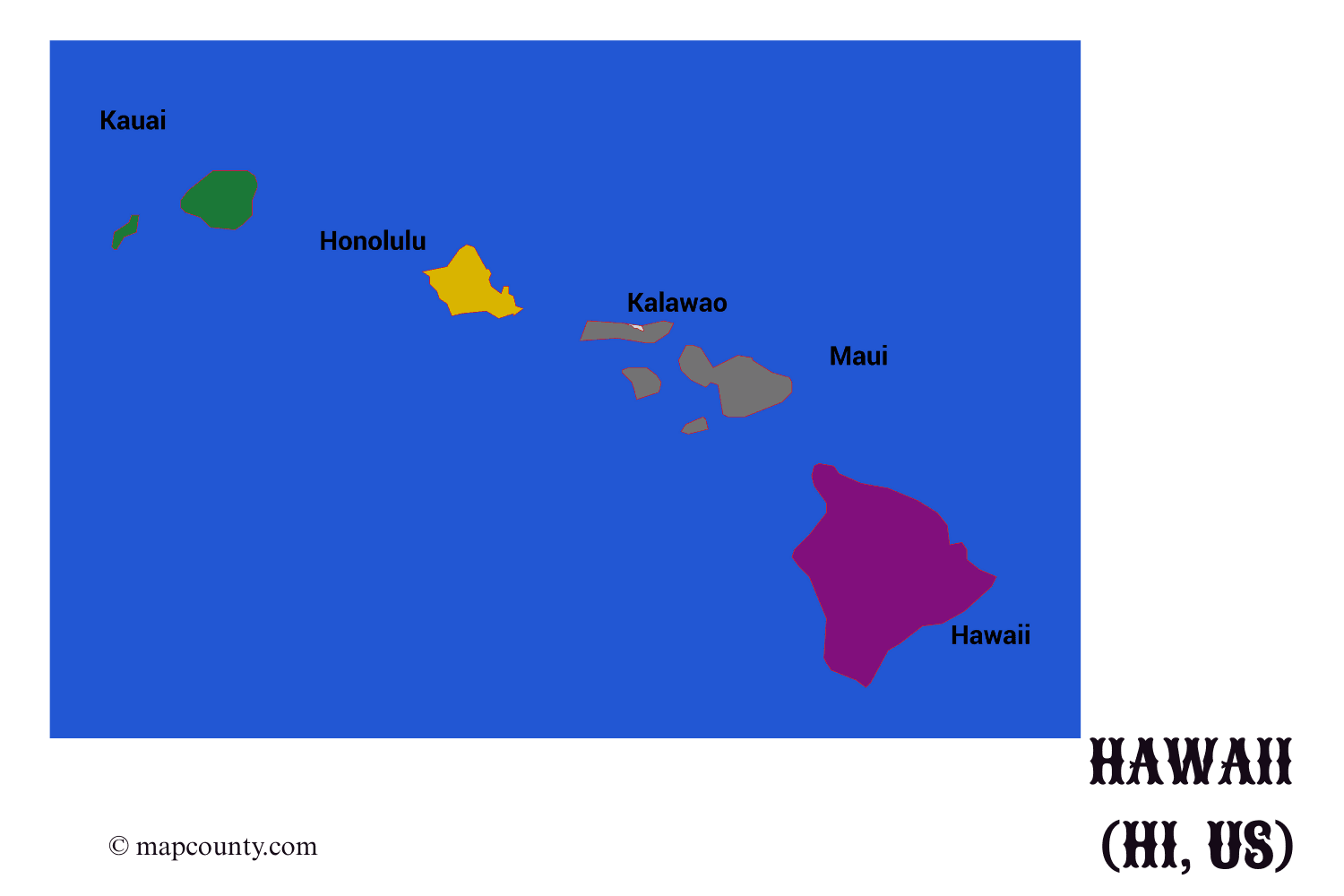
Hawaii is divided into five counties: Hawaii, Honolulu, Kalawao, Kauai, and Maui. Four operate under the state’s regular county government system, while Kalawao has a separate administrative arrangement. These geographic divisions cover the Hawaiian Islands, including communities on Oahu, Maui, Kauai, Hawaii Island, Molokai, and Lanai.
The distinction between Hawaii County and the State of Hawaii is important. Hawaii County covers the island of Hawaii, commonly called the Big Island. The other four counties contain the remaining islands and their associated communities.
Hawaii State County Map
PDF: Hawaii State County Map PDF
Hawaii Counties, County Seats, and Land Areas
The table lists all five Hawaiian counties, their administrative centers, establishment years, land areas, and selected communities. The area figures use the 2020 U.S. Census land-area measurements reported in Table 5.09 of the State of Hawaii Data Book 2024.
| County | County Seat / Administration | Established | Land Area (sq mi) | Major Cities and Towns |
|---|---|---|---|---|
| Hawaii | Hilo | 1905 | 4,028.4 | Hilo, Kailua-Kona, Waimea, Pahoa |
| Honolulu | Honolulu | 1907 | 600.6 | Honolulu, Pearl City, Waipahu, Kaneohe |
| Kalawao | No conventional county seat; administered by the Hawaii Department of Health | 1905 | 12.0 | Kalaupapa Settlement |
| Kauai | Lihue | 1905 | 619.9 | Lihue, Kapaa, Hanalei, Koloa |
| Maui | Wailuku | 1905 | 1,161.5 | Wailuku, Kahului, Lahaina, Kihei, Kaunakakai, Lanai City |
Land area versus total area: All five measurements represent land only. Ocean waters and other water surfaces are excluded. This distinction is particularly relevant for Honolulu, Kalawao, and Kauai, whose total geographic areas can be much larger when surrounding waters are included.
The counties were established under Hawaii’s territorial government in 1905. The City and County of Honolulu was subsequently incorporated in 1907, replacing the earlier County of Oahu arrangement.
Hawaii County is the largest county by land area, covering approximately 4,028.4 square miles, or nearly 63% of the state’s land. Kalawao County is the smallest, occupying approximately 12.0 square miles on the northern coast of Molokai.
Geography and Nature
Hawaii’s county geography is shaped by its islands. Unlike counties in most mainland states, several Hawaiian counties consist of multiple islands or separated land areas.
Hawaii County occupies the Big Island, the southeasternmost major island in the archipelago. It contains Mauna Loa, Kilauea, Mauna Kea, extensive volcanic landscapes, tropical forests, and coastal communities. Hilo is the county seat on the eastern side of the island, while the Kailua-Kona area is a major population and commercial center on the western coast.
Honolulu County covers Oahu, the state’s principal population center, along with certain outlying Northwestern Hawaiian Islands. Honolulu is both the state capital and the administrative center of the consolidated City and County of Honolulu. Communities such as Pearl City, Waipahu, Kaneohe, and Kailua are also located on Oahu.
Kauai County includes Kauai and Niihau, together with smaller associated islands. Its administrative center is Lihue, on the southeastern coast of Kauai. The county contains the Waimea Canyon region, the Na Pali Coast, and communities such as Kapaa, Hanalei, and Koloa.
Maui County includes the islands of Maui, Lanai, Kahoolawe, and most of Molokai. Wailuku is its county seat, while Kahului is another major population and transportation center. On Molokai, Maui County surrounds the separate Kalawao County area on the island’s northern peninsula.
Kalawao County occupies the Kalaupapa Peninsula and nearby Kalawao and Waikolu areas on Molokai. Its boundaries are geographically distinct from Maui County despite being located on the same island.
County Administration and Kalawao’s Special Status
Hawaii’s four principal county governments are the County of Hawaii, City and County of Honolulu, County of Kauai, and County of Maui. They administer local services under their respective charters and state law.
Honolulu operates as a consolidated city-county government. Hawaii, Kauai, and Maui counties administer communities across their respective island territories, including multiple islands in the cases of Kauai and Maui.
Kalawao County follows a different system. It does not have an ordinary elected county government, mayor, or conventional county seat. Under Hawaii Revised Statutes §326-34, Kalawao is administered by the Hawaii Department of Health, reflecting the history of the Kalaupapa Settlement and the state’s responsibilities toward residents affected by Hansen’s disease.
Kalaupapa is the settlement associated with this special county arrangement. It should not be treated as an ordinary county seat comparable to Hilo, Honolulu, Lihue, or Wailuku. The area also contains Kalaupapa National Historical Park, where the National Park Service works with state agencies on land management and preservation.
Kalawao’s future administrative status is subject to a legal transition. Hawaii’s Act 171, signed on June 26, 2026, provides for changes to the Department of Health’s responsibilities and the eventual incorporation of Kalawao into Maui County. The provisions ending Kalawao’s separate county status are scheduled to take effect one year after the death of the last full-time or part-time patient resident of Kalaupapa, as affirmed by a governor’s proclamation.
The enactment of Act 171 does not itself mean that the county merger has already taken effect. Until the statutory condition is satisfied and the relevant provisions become effective, Kalawao remains separately identified as Hawaii’s fifth county.
Major Cities and Communities by County
- Hawaii County: Hilo is the administrative center and one of the island’s main population centers. Kailua-Kona serves communities along the western coast, while Waimea and Pahoa are important local settlements in different parts of the island.
- Honolulu County: Honolulu contains the state government headquarters and much of Oahu’s urban area. Pearl City, Waipahu, Kaneohe, Kapolei, and Kailua are additional communities within the same county.
- Kauai County: Lihue is the county seat, while Kapaa, Hanalei, Koloa, and other settlements are distributed along Kauai’s coastal road network. Niihau is also part of the county.
- Maui County: Wailuku and Kahului are located on the island of Maui. Lahaina and Kihei occupy other coastal areas, while Kaunakakai on Molokai and Lanai City on Lanai belong to the same county jurisdiction.
- Kalawao County: Kalaupapa is the principal settlement. Its administration and geographic circumstances differ from those of the other four counties.
County Boundaries Across the Hawaiian Islands
Hawaii’s county boundaries do not correspond to a simple division into five individual islands. Maui County spans several islands, while Molokai is divided between Maui County and Kalawao County. Kauai County includes Niihau, and Honolulu County includes Oahu and certain outlying islands.
These distinctions affect geographic data, local government jurisdiction, property records, and the interpretation of county maps. A community’s island and its county are not always identified by the same name.
Most notably, Hawaii County refers specifically to the Big Island, while the State of Hawaii includes all five counties. Likewise, the City and County of Honolulu covers far more than the urban center of Honolulu, and Maui County extends beyond the island of Maui.
The five-county classification also remains relevant to Census geography and statewide statistical reporting. Kalawao continues to be represented separately in county geographic datasets while its future administrative transition remains subject to the conditions established under Hawaii law.