Florida, located in the Southeastern United States, is composed of 67 counties. Admitted to the Union as the 27th state in 1845, Florida is known for its stunning coastlines, vibrant cities, and diverse cultural heritage. This guide provides a detailed look at Florida’s county and city structure.
✅Florida County Map
The map below shows the geographical distribution of Florida’s 67 counties:
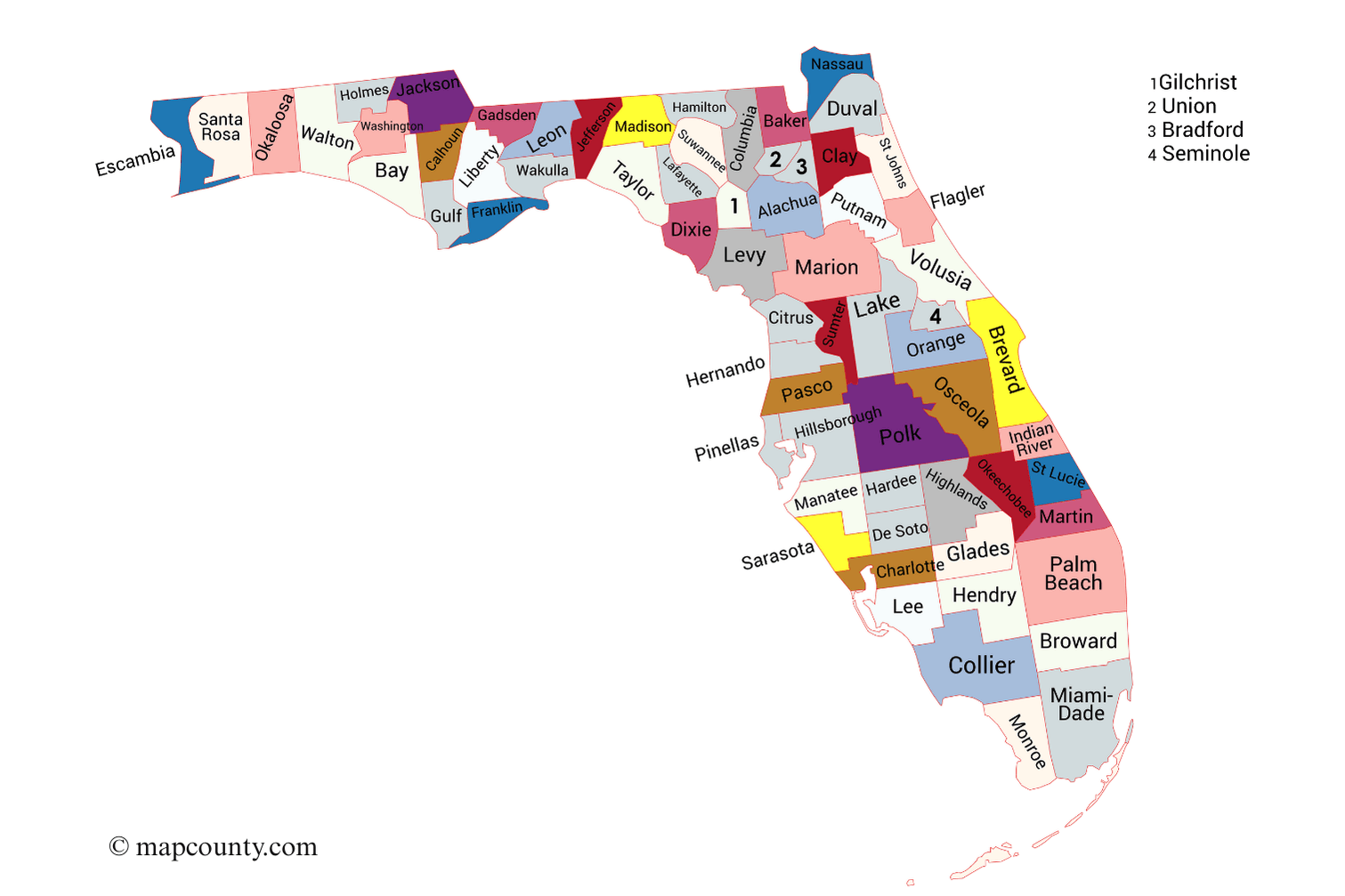
✅Florida Counties with County Seats, Founded Dates, and Areas
| County | County Seat | Founded | Area (sq mi) | Notes / Major Cities |
|---|---|---|---|---|
| Alachua | Gainesville | 1824 | 969 | Home to the University of Florida; vibrant college town |
| Baker | Macclenny | 1861 | 589 | Rural county in Northeast Florida |
| Bay | Panama City | 1913 | 1,033 | Gulf Coast beaches; tourism center |
| Bradford | Starke | 1858 | 300 | Small rural population; agriculture |
| Brevard | Titusville | 1844 | 1,016 | Space Coast; Kennedy Space Center |
| Broward | Fort Lauderdale | 1915 | 1,209 | Major urban county; Miami metro suburbs |
| Calhoun | Blountstown | 1838 | 574 | Rural county; agricultural economy |
| Charlotte | Punta Gorda | 1921 | 858 | Gulf Coast; retirement communities |
| Citrus | Inverness | 1887 | 773 | Nature preserves and rivers |
| Clay | Green Cove Springs | 1858 | 644 | Jacksonville suburbs |
| Collier | Naples | 1923 | 2,305 | Gulf Coast; luxury resorts |
| Columbia | Lake City | 1832 | 801 | Historic towns; crossroads of I-75 and I-10 |
| DeSoto | Arcadia | 1887 | 639 | Agricultural county |
| Dixie | Cross City | 1921 | 864 | Rural; Suwannee River area |
| Duval | Jacksonville | 1822 | 918 | Largest city by area in the continental US |
| Escambia | Pensacola | 1821 | 875 | Gulf Coast; naval bases |
| Flagler | Bunnell | 1917 | 571 | Fast-growing coastal county |
| Franklin | Apalachicola | 1832 | 1,037 | Coastal fishing communities |
| Gadsden | Quincy | 1823 | 534 | Tallahassee suburbs; agriculture |
| Gilchrist | Trenton | 1925 | 355 | Smallest population county; rivers and springs |
| Glades | Moore Haven | 1921 | 987 | Lake Okeechobee region |
| Gulf | Port St. Joe | 1925 | 747 | Gulf Coast beaches |
| Hamilton | Jasper | 1827 | 519 | Rural county; Suwannee River |
| Hardee | Wauchula | 1921 | 638 | Agricultural economy |
| Hendry | LaBelle | 1923 | 1,190 | Citrus groves and cattle ranching |
| Hernando | Brooksville | 1843 | 589 | Nature preserves; suburban growth |
| Highlands | Sebring | 1921 | 1,106 | Lakes and tourism; Sebring International Raceway |
| Hillsborough | Tampa | 1834 | 1,051 | Major urban county; port city and business hub |
| Holmes | Bonifay | 1848 | 489 | Rural county; forests and agriculture |
| Indian River | Vero Beach | 1925 | 617 | Coastline and citrus production |
| Jackson | Marianna | 1822 | 955 | Agriculture and historical sites |
| Jefferson | Monticello | 1827 | 637 | Rural; near Tallahassee |
| Lafayette | Mayo | 1856 | 548 | Small rural population |
| Lake | Tavares | 1887 | 1,157 | Lakes and suburban growth |
| Lee | Fort Myers | 1887 | 1,212 | Gulf Coast; Fort Myers metro area |
| Leon | Tallahassee | 1824 | 702 | State capital; Florida State University |
| Levy | Bronson | 1845 | 1,412 | Nature preserves; Gulf Coast access |
| Liberty | Bristol | 1855 | 843 | Rural; forests and rivers |
| Madison | Madison | 1824 | 716 | North Florida; small towns |
| Manatee | Bradenton | 1855 | 893 | Gulf Coast; tourism and agriculture |
| Marion | Ocala | 1844 | 1,663 | Horse farms; Ocala metro area |
| Martin | Stuart | 1925 | 762 | Treasure Coast; coastal communities |
| Miami-Dade | Miami | 1836 | 1,899 | Largest population; major international city |
| Monroe | Key West | 1823 | 3,738 | Florida Keys; tourism and fishing |
| Nassau | Fernandina Beach | 1824 | 726 | Northeast border; suburban growth |
| Okaloosa | Crestview | 1915 | 1,082 | Northwest Florida; Eglin Air Force Base |
| Okeechobee | Okeechobee | 1917 | 892 | Lake Okeechobee region; agriculture |
Geographical and Cultural Diversity
Florida’s counties have diverse geographical features, from the Everglades in the south to the Apalachicola forests in the north. The state is home to a mix of cultures, including large Hispanic, African American, and Caribbean communities. Population density varies greatly, with major urban centers like Miami, Orlando, and Tampa contrasting with rural counties like Liberty and Union. The state’s long coastline supports tourism, trade, and recreation, while inland areas focus on agriculture and suburban development.
Geography and Climate
Florida is a peninsula with over 1,300 miles of coastline, including famous beaches such as Miami Beach, Clearwater Beach, and Daytona Beach. The state features diverse geographical areas, from the Everglades, a unique wetland ecosystem in the south, to the Panhandle’s forests and rivers. Florida has a subtropical to tropical climate, with hot, humid summers and mild winters, making it a popular destination for tourists and retirees alike.
Culture and Lifestyle
Florida is a cultural melting pot, with strong Hispanic, Caribbean, and African American communities influencing music, food, and traditions. The state is also home to major universities, professional sports teams, and cultural events. Popular activities include boating, fishing, golfing, and visiting natural parks.
Economy and Tourism
Florida’s economy is driven by tourism, agriculture, aerospace, international trade, and technology. Visitors flock to the state for its beaches, theme parks, and warm climate. Citrus fruits, sugarcane, and livestock are key agricultural products. The state’s ports, especially Miami and Tampa, facilitate international trade and commerce.
Natural Wonders
Everglades National Park: A UNESCO World Heritage Site, home to alligators, panthers, and unique wetlands.
Florida Keys: A tropical chain of islands ideal for snorkeling, diving, and marine life exploration.
St. Johns River: One of the longest rivers in Florida, supporting ecosystems and recreational activities.
Conclusion
Florida offers a unique combination of natural beauty, urban sophistication, and cultural diversity. From the sandy beaches of Miami to the theme parks of Orlando and the wilderness of the Everglades, Florida attracts millions of residents, tourists, and business investors every year. Its dynamic cities, warm climate, and vibrant lifestyle make it one of the most iconic states in the United States.
More USA County Maps
- South Dakota County Map with Cities and Towns [SD, US]
- South Carolina County Map with Cities and Towns [SC, US]
- North Carolina County Map with Cities and Towns [NC, US]
- North Dakota County Map with Cities and Towns [ND, US]
- Wyoming County Map with Cities and Towns [WY, US]
- Wisconsin County Map with Cities and Towns [WI, US]